The Healthy Trajectories team is proud to offer a uniquely tailored Family Engagement in Research (FER) course for our Australian researchers and family engagement partners, which runs annually.
Applications for the 2024 cohort are now closed, but you can learn more about our FER course below.
What is the FER course?
The Family Engagement in Research (FER) course is a course offered by Healthy Trajectories in partnership with CanChild Centre for Childhood Disability Research, McMaster University. The FER course covers principles and frameworks of family engagement in research alongside discussions of the practicalities and challenges of research partnership.
Who is the FER course aimed at?
Researchers working or aspiring to work in the field of child and youth health and disability research who would like to know how to partner withconsumers genuinely and effectively in their research.
People with lived/living experience of child/youth-onset disability or other chronic health conditions (as a young adult or parent/caregiver) who are currently involved or would like to become involved in research as a family engagement partner (consumer).
What do participants do during the FER course?
The course design and content aim to create a supportive environment to share ideas, experiences, and practical working methods to help participants develop confidence and competence in both the theory and practice of family engagement in research. A unique component of the FER course is that individuals with lived experience of disability and researchers collaborate in small groups to create a Knowledge Translation (KT) tool.
What kind of KT tools do participants make?
The KT tools aim to highlight best practices in FER and are produced by small groups, but the exact format of the KT tool can vary from group to group.
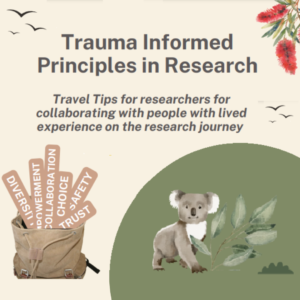
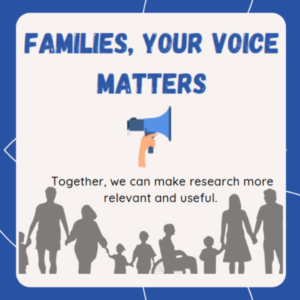
Below are some examples from previous years’ participants in the FER course.